


Wine from the Wachau – Austria’s most famous wine region explained
Everything you need to know about the Wachau.
The Wachau is one of the most famous wine regions in Austria and enjoys an outstanding reputation worldwide. Along the Danube between Melk and Krems, elegant white wines are produced that combine freshness, structure and remarkable precision.
Grüner Veltliner and Riesling in particular reach exceptional quality in this region. The combination of steep vineyards, ancient soils and strong day-night temperature differences creates wines with great balance and character.
Wachau at a glance
- Location: Lower Austria along the Danube between Melk and Krems
- Vineyard area: approx. 1,300–1,350 hectares
- Main grape varieties: Grüner Veltliner, Riesling, Neuburger, Pinot Blanc
- Climate: warm Pannonian influence and cool air from the Waldviertel
- Soils: mainly primary rock such as gneiss and mica schist
- Famous wine styles: Steinfeder, Federspiel and Smaragd
- Classification: Wachau DAC since 2020
Why wines from the Wachau are so special
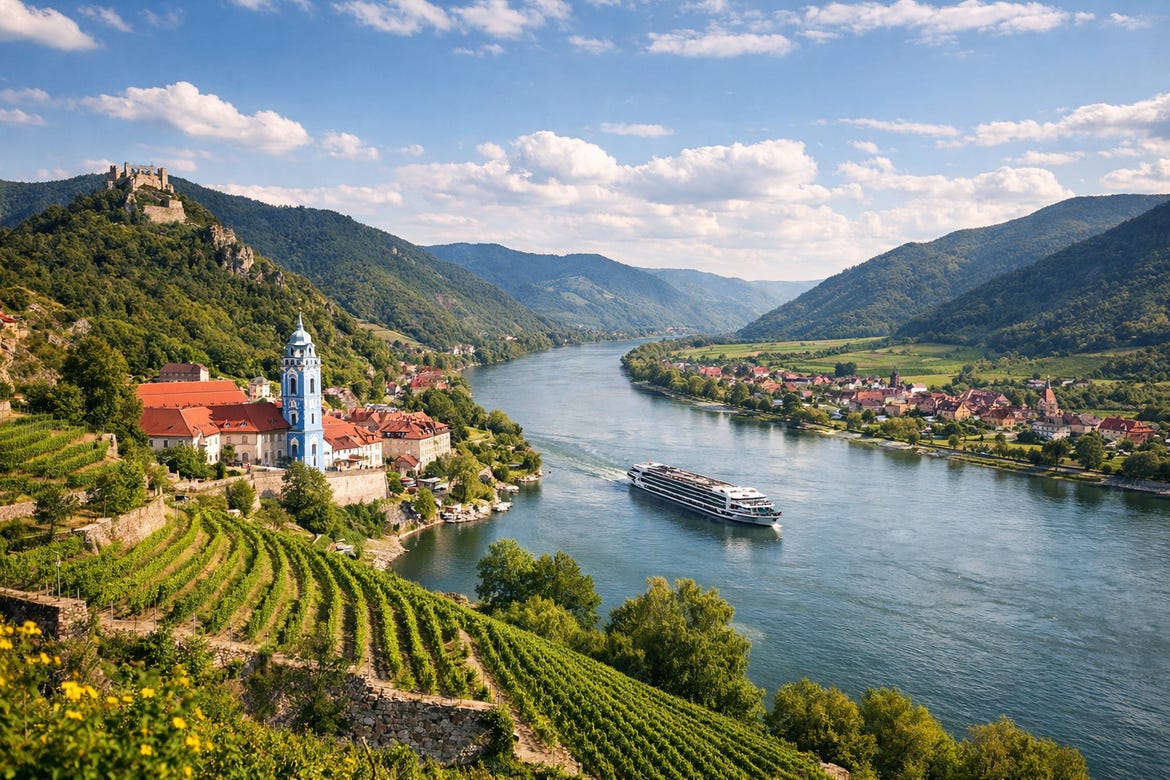
Few wine regions in Europe combine landscape and winemaking as dramatically as the Wachau. The Danube flows through a narrow valley surrounded by steep terraced vineyards that have been cultivated for centuries.
These terraces are not only visually spectacular but also extremely demanding to work in. Many vineyards are so steep that most of the work must still be done by hand. The result is wines that often show remarkable precision and elegance.
Climate and soils of the Wachau
The special climate along the Danube
The Wachau benefits from a unique interaction of climatic influences. Warm air from the east meets cooler air coming from the Waldviertel region in the north. These strong temperature differences between day and night help the grapes ripen slowly while preserving freshness and aromatic complexity.
Primary rock and terraced vineyards
Many vineyards in the Wachau are planted on ancient primary rock soils such as gneiss and mica schist. These soils are poor in nutrients and store little water. As a result, the vines must develop deep roots, which often leads to wines with great structure and minerality.
In lower areas, loess soils also appear and are particularly suitable for Grüner Veltliner.
Wachau DAC – origin with clear rules
Since the 2020 vintage the Wachau is officially classified as a DAC wine region. DAC stands for “Districtus Austriae Controllatus” and emphasizes the importance of origin. The system distinguishes between three levels: regional wines, village wines and single-vineyard wines. Single-vineyard wines in particular highlight the unique character of individual sites.
Main grape varieties of the Wachau
The region is dominated by two grape varieties.
Grüner Veltliner is the most widely planted grape and produces wines that are often fresh, spicy and elegant.
Riesling is typically grown on the steepest terraces and is known for its precise, mineral style.
Smaller plantings include Neuburger, Pinot Blanc, Chardonnay and Muscat.
Steinfeder, Federspiel and Smaragd
A special feature of the Wachau is the classification system created by the association Vinea Wachau. These three categories describe the style and strength of the wines.
Steinfeder
The lightest wines of the Wachau with up to 11.5% alcohol. They are fresh, lively and usually meant to be enjoyed young.
Federspiel
Medium-bodied wines with around 11.5–12.5% alcohol. They are balanced, elegant and excellent food companions.
Smaragd
The most powerful wines with at least 12.5% alcohol. These wines are concentrated, complex and often have great ageing potential.
Famous vineyards of the Wachau
Some of the most prestigious vineyards in the Wachau include:
- Singerriedel in Spitz
- Achleiten in Weißenkirchen
- Kellerberg in Dürnstein
- Loibenberg in Loiben
- Tausendeimerberg in Spitz
Important wine villages in the Wachau
Dürnstein
Dürnstein is one of the most picturesque towns in the Wachau and a central location for winemaking in the region. The famous Kellerberg vineyard is located here.
Weißenkirchen
Weißenkirchen is considered one of the historic centers of Wachau wine production and is surrounded by impressive terraces.
Spitz
Spitz lies in the western part of the Wachau and is home to the famous Singerriedel vineyard.
Loiben
Unterloiben and Oberloiben are known for powerful wines from the well-known Loibenberg vineyard.
Which foods pair well with Wachau wines?
The freshness and structure of Wachau wines make them excellent food partners. They pair particularly well with fish and seafood, Asian cuisine, poultry and classic Austrian dishes such as Wiener Schnitzel. Federspiel wines are especially versatile with food, while Smaragd wines can easily accompany richer dishes.
Conclusion: why Wachau wines are so popular
The Wachau is one of the most fascinating wine regions in Europe. Steep terraced vineyards, ancient soils and a unique climate produce wines with character and elegance.
Grüner Veltliner and Riesling from the Wachau show impressive diversity — from light and refreshing styles to powerful wines with great ageing potential.
Latest reviews
-
Don Román 6+3 Gratis Cava Brut Bundle from Don Román, 6+3 Set
- Made according to the "méthode traditionnelle"
- Fine cava for lovers of high quality sparkling wine
- Great balance of acidity and sweetness
-
-
Markus Huber New Chapter Grüner Veltliner 2025 Bio, 0,75 l
- Innovative white wine project from 2 great winegrowers
- Grüner Veltliner matured in barriques
- Shows what is possible with this grape variety
-
-
Dominio Imperfetto White Scandal Bio 2025, 0,75 l
- A blend of Chardonnay, Sauvignon Blanc and Pecorino
- Fresh, juicy and aromatic with a lovely finish
- Citrus, light fruits and a subtle herbal note
-
-
Muster.Gamlitz Merlot Pannonica 2018, 0,75 l
- Strong, well-ripened red wine
- Vinified by the top Gesellmann winery
- Matured for 24 months in barriques
-






Magazine Articles:
Discover 9wines CH:
-
Switzerland: Free standard delivery from CHF 80.00
-
We operate in a
climate-conscious manner. Secure payments
with SSL encryption technology