


Spanish red wine: an overview of grape varieties, regions and styles
Spanish red wine is among the most exciting in Europe. From fruity everyday reds to great Rioja classics, Spain offers remarkable variety. In this article, you’ll discover which grape varieties, regions and ageing categories shape Spanish red wines.
Spain and red wine simply belong together. Hardly any other country combines tradition, diversity and character in the glass quite like Spain. From juicy, fruit-driven Tempranillo to powerful Garnacha, Spanish red wine can be incredibly varied, but it almost always has one thing in common – it is wonderfully drinkable.
Spain is not only exciting in terms of quality, but also impressive in scale. With around 900,000 hectares of vineyards, it has the largest vineyard area in the world. Of that, around 550,000 hectares are planted with red grape varieties, which means well over half of the country’s total vineyard surface is dedicated to red wines.
No surprise then that Spanish red wine shows such an enormous range. Different climates, soils and altitudes give each region its own distinctive character.
So if you feel like taking a little journey through Spain’s wine landscape, pour yourself a glass and come along.
Browse our selection of Spanish wines here
The remarkable range of Spanish red wine
What makes Spain stand out from many other wine-producing countries is the sheer breadth of styles. Here you’ll find everything from easy-drinking everyday reds to truly top-level wines.
Many young red wines are fruity, juicy and wonderfully approachable. These are exactly the kinds of wines you open without overthinking it, and they deliver immediate enjoyment – perfect for dinner, a relaxed evening or simply a good glass at the end of the day.
At the same time, Spain also produces serious fine wines that can easily stand alongside some of the world’s great reds. In regions such as Ribera del Duero and Rioja, some wines spend years ageing in oak and then continue to develop in bottle for a long time.
The result is red wine with depth, structure and complex aromas. And it is precisely this combination of easy enjoyment and real quality that makes Spain so fascinating.
The most important red grape varieties in Spain
Spain is home to a huge number of grape varieties, but a few have a particularly strong influence on the country’s red wine identity. These five varieties make up a large share of Spain’s red vineyards and stand behind many of its best-known wines.
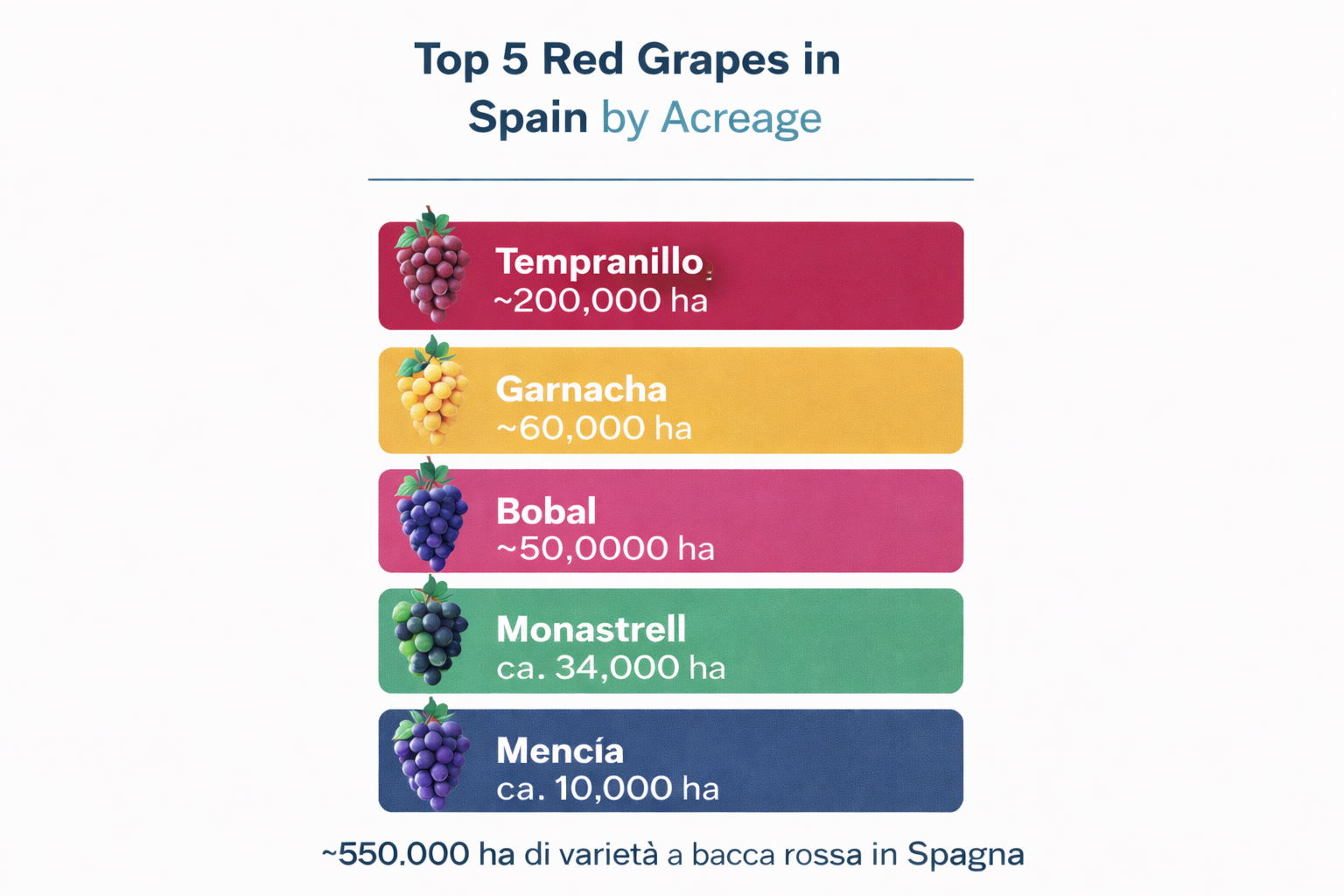
Infobox: The 5 most important red grape varieties in Spain
Tempranillo – approx. 200,000 ha
Spain’s most important red grape, with dark fruit, fine spice and elegant structure.
Garnacha – approx. 60,000 ha
Fruit-forward, generous wines with warmth and a distinctly Mediterranean feel.
Bobal – approx. 50,000 ha
Dark, characterful reds, especially from the Utiel-Requena area.
Monastrell – approx. 34,000 ha
Spicy, powerful wines from warm regions such as Jumilla and Yecla.
Mencía – approx. 10,000 ha
Fresher, more elegant red wines mainly from north-western Spain.
Tempranillo – Spain’s signature red grape
When talking about Spanish red wine, Tempranillo is impossible to ignore. It is the heart of many of the country’s wines and one of Spain’s clearest calling cards in the glass.
With around 200,000 hectares under vine, Tempranillo is Spain’s most widely planted grape variety and accounts for roughly one fifth of the country’s total vineyard area.
You’ll often find aromas of dark cherries, ripe berries, gentle spice and a soft, polished structure. In younger styles, it tends to be juicy and fruit-driven. With oak ageing, it gains more depth, added complexity and more pronounced spicy notes.
It is especially famous in Rioja and Ribera del Duero. These regions show just how elegant, deep and yet approachable Spanish red wine can be.
Discover our Tempranillo wines here
Garnacha – generous, juicy and full of energy
With around 60,000 hectares planted, Garnacha is also one of Spain’s key red grape varieties. It often produces expressive, juicy wines with plenty of warmth and charm.
Typical aromas include ripe cherries, red berries and Mediterranean herbs. In regions such as Priorat, Campo de Borja and Calatayud, Garnacha gives rise to highly characterful wines with real depth.
It shows especially well how much richness, fruit and energy Spanish red wine can offer without becoming heavy.
Bobal – Spain’s great hidden gem
With around 50,000 hectares under vine, Bobal is another of Spain’s major red varieties. Its historic home is the Utiel-Requena area near Valencia.
For a long time, Bobal was mainly used for simpler wines, but today many producers are showing just how much potential this grape really has. Especially from old vines, it can produce dark, spicy and surprisingly refined reds with plenty of personality.
Monastrell – power and character from the south-east
Monastrell covers around 34,000 hectares in Spain. In the hot south-east, it produces intense red wines packed with dark fruit, spice and structure.
Regions such as Jumilla and Yecla are particularly well known for it. Here Monastrell shows just how well it handles heat and how much character it can bring into the glass.
The key red wine regions of Spain
Rioja
Rioja is probably Spain’s most famous wine region. It produces elegant red wines with a beautiful balance of fruit, spice and finely integrated oak. It is one of the classic and most compelling expressions of Tempranillo.
Ribera del Duero
Wines from Ribera del Duero are often more intense and structured. The region’s altitude helps create reds with depth, concentration and strong character. If you enjoy wines with presence and power, this is a region worth discovering.
Priorat
Priorat is one of Spain’s most dramatic wine regions. Its poor slate soils give rise to concentrated, deep and often distinctly mineral reds. These are powerful wines, but with enormous personality.
Toro
Toro stands for bold, energetic reds with lots of structure and intense dark fruit. It represents one of the more forceful and robust sides of Spanish red wine.
Jumilla
In Spain’s warm south-east, Jumilla produces deeply characterful Monastrell-based reds. These wines are often spicy, intense and full of personality, and the region has developed enormously in quality over recent years.
What do Crianza, Reserva and Gran Reserva mean?
If you explore Spanish red wine, sooner or later you’ll come across terms such as Crianza, Reserva and Gran Reserva. These classifications mainly indicate how long a wine has been aged before release.
Crianza
For red wine, a Crianza must age for at least two years, including at least six months in oak. These wines often show a lovely balance between fruit and spice. The fruit remains clearly present, supported by gentle oak notes and a little more structure.
Reserva
A Reserva requires a longer ageing period. These wines must mature for at least three years, including at least one year in oak. That extra time gives them more depth, added complexity and a rounder structure. Alongside the fruit, you’ll often notice spice and subtle toasted notes.
Gran Reserva
Gran Reserva is the highest classic ageing category for many Spanish red wines. Here, the wine must mature for at least five years, including at least two years in oak. These wines often show considerable complexity and are usually only produced in particularly strong vintages.
Spanish red wine – easy to enjoy or truly great
What makes Spanish red wine so compelling is its sheer diversity. Very few wine countries combine such a broad range of styles so convincingly.
Here you’ll find fruit-forward everyday reds with plenty of drinkability, regional specialties full of character and high-end wines with excellent ageing potential. Whether you are looking for a juicy Tempranillo for the evening, a spicy Garnacha at the table or a powerful Ribera del Duero for a special occasion, Spain almost always has the right bottle.
And that is exactly what makes Spanish red wine so appealing – this combination of tradition, variety and pure drinking pleasure. In other words: these are wines you’ll happily open, pour and enjoy together.
Latest reviews
-
La Pruina Vini 6+3 FREE Primitivo Puglia IGT 2025, 9 x 0.75 l
- Top-selling wine with a moderate alcohol content
- Trendy wine from Apulia
- Extremely fruity and inviting
-
-
Tegernseerhof Mittelbach Riesling Ried Loibenberg Smaragd 2014 Late Release, 0,75 l
- Famous Wachau vineyard Riesling
- Ready to drink, stored in the winery for 10 years
- Dry with unique minerality
-
-
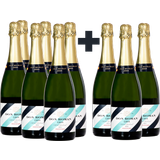
Don Román 6+3 Gratis Cava Brut Bundle from Don Román, 6+3 Set
- Made according to the "méthode traditionnelle"
- Fine cava for lovers of high quality sparkling wine
- Great balance of acidity and sweetness
-
-
Markus Huber New Chapter Grüner Veltliner 2025 Bio, 0,75 l
- Innovative white wine project from 2 great winegrowers
- Grüner Veltliner matured in barriques
- Shows what is possible with this grape variety
-






Magazine Articles:
Discover 9wines CH:
-
Switzerland: Free standard delivery from CHF 80.00
-
We operate in a
climate-conscious manner. Secure payments
with SSL encryption technology